This guide will:
- Clarify what a wallet is
- Explain the difference between hot and cold wallets
- Help users choose the right type of wallet for their needs
- Naturally link to your visual content and related guides
What Is a Crypto Wallet?
A crypto wallet is a tool that lets you store, send, and receive cryptocurrencies like Bitcoin and Ethereum. Unlike a physical wallet that holds cash, a crypto wallet stores the private keys that allow you to access your digital assets.
Think of it like a digital vault — only you have the keys.
Key Concept: You Don’t Store Coins, You Store Keys
Cryptocurrency “lives” on the blockchain — your wallet simply holds the keys that let you prove ownership and unlock access to those coins.
- Public Key: Like your email address — share it to receive funds.
- Private Key: Like your password — keep it secret. Whoever has this can spend your crypto.
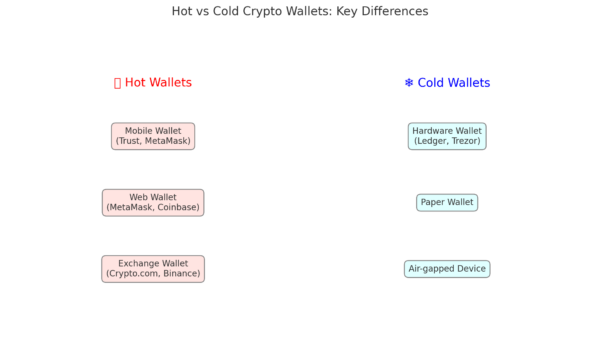
Hot Wallets vs ❄️ Cold Wallets: What’s the Difference?
The main difference between hot and cold wallets is whether or not they’re connected to the internet.
Hot Wallets (Online)
Connected to the internet. Easy to access, fast for trading and daily use.
| Type | Examples | Pros | Cons |
|---|---|---|---|
| Mobile App | Trust Wallet, Crypto.com | Convenient, free | More vulnerable to hacks |
| Web Wallet | MetaMask, Coinbase Wallet | Browser-based | Risk if browser/device is compromised |
| Exchange Wallet | Binance, Crypto.com | No setup needed | You don’t control the keys (“not your keys…”) |
? Best For: Beginners, casual users, frequent trading
❄️ Cold Wallets (Offline)
Stored entirely offline. Best for long-term holding and large amounts of crypto.
| Type | Examples | Pros | Cons |
|---|---|---|---|
| Hardware Wallet | Ledger, Trezor | Most secure, portable | Costs money, needs setup |
| Paper Wallet | QR code on paper | Fully offline | Can be lost/damaged, not user-friendly |
| Air-gapped Device | USB or dedicated offline PC | Ultimate privacy | Advanced use case only |
? Best For: Long-term holders, security-focused users
So… Which Wallet Should You Use?
It depends on what you’re doing:
| User Type | Recommended Wallet |
|---|---|
| Total Beginner | Crypto.com (built-in exchange wallet) |
| Mobile User | Trust Wallet, MetaMask mobile |
| Long-Term Holder | Ledger Nano S/X or Trezor One |
| Privacy-Focused | Paper wallet or air-gapped device |
Common Wallet Mistakes to Avoid
- ❌ Losing your seed phrase (you can’t recover lost crypto!)
- ❌ Leaving large amounts on exchanges
- ❌ Sharing your private key (never do this!)
- ❌ Not using 2FA (two-factor authentication)
Related Guides:
- ? How to Buy Crypto in the UK (Beginner’s Guide)
- ? Crypto Mining Explained + Enter Our Mining Device Giveaway
- ? Crypto.com Review
Final Thoughts
A crypto wallet is one of the most important tools in your crypto journey. Whether you’re trading daily or holding long-term, choosing the right wallet — and protecting your private keys — is essential.
You don’t need to be a tech expert to use one. Just remember:
“Not your keys, not your coins.”
Related Posts
- Crypto Wallet Security Tips: Keep Your Cryptocurrency Safe
- What Is Cryptocurrency? A Beginner’s Guide to Crypto
- How to Buy Cryptocurrency in the UK: A Beginner’s Guide
- What Is Crypto Mining? A Beginner’s Guide
- What Is DeFi? A Beginner’s Guide to Decentralized Finance
- What Are NFTs? A Beginner’s Guide to Non-Fungible Tokens
Seed Phrases: Back Up and Protect Your Recovery Keys
Whether you’re using a hot or cold wallet, the most important tool you own is not the wallet itself — it’s your seed phrase (also called a recovery phrase or mnemonic seed). This is a sequence of 12 or 24 random words that acts as a master backup for your entire wallet.
When you create a new wallet, your software generates a seed phrase and displays it once. This phrase is mathematically linked to all your private keys. If you lose access to your wallet — whether due to a lost phone, forgotten password, hardware failure, or the company shutting down — you can recover everything using only this phrase. It’s your insurance policy.
How to Safely Back Up Your Seed Phrase
- Write it down on paper. Keep a physical copy in a safe place — not stored digitally where hackers can find it. Use a pen and write clearly, leaving no room for misreading.
- Never photograph or screenshot it. Cloud storage and phone backups are vulnerable to hacking. Digital copies are a security risk.
- Use two or three copies. Keep one at home in a safe or lockbox, and one in a secure location outside your home — like a safe-deposit box at your bank or with a trusted family member.
- Never type it into emails, notes apps, or messaging services. Digital storage is a honeypot for thieves and hackers.
- Consider a metal backup. Specialised metal seed-phrase storage tools (like Cryptosteel) are fireproof and waterproof — far more durable than paper over decades.
The golden rule: your seed phrase is equivalent to ownership of your crypto. Treat it like you would treat a deed to a house or the title to a car. Anyone with access to your seed phrase can steal all your cryptocurrency in minutes, completely unrecoverably.
Most wallet hacks don’t happen because the software is flawed — they happen because someone accessed the user’s seed phrase, password, or recovery email account. Protect this information as if your financial future depends on it, because it genuinely does.